Build a stuck-location map
For a week, record the place, time, weather, battery level, error message, and which part of the mower contacted the terrain. Clusters reveal the cause: one tree root calls for landscaping; scattered wet-morning failures suggest traction; repeated stops at the same narrow gate suggest route width or boundary geometry. Preserve app history and photographs before clearing each scene.
Separate grounding from traction loss
A mower can have spinning wheels while its deck or nose rests on a hump. Inspect wheel marks and underside contact points. Fill holes, ease abrupt crests, remove exposed stones, and stabilize soft approaches with lawn-compatible work. Do not automatically add aggressive tires when the chassis is carrying weight; more wheel grip cannot free a mower that is high-centered.
Remove entrapment hazards
Raise or exclude low netting, slack hose, toys, fallen fruit, cords, landscape fabric, and flexible edging. Trim branches to the safe clearance and prevent access beneath vehicles, furniture, or trampolines. Small objects can become blade hazards, not merely obstacles. Walk the active zone before scheduled runs, especially after storms, parties, or yard work.
Give complex routes enough room
Measure passages using the manufacturer’s boundary and transit requirements, not just the mower’s body width. A robot needs space to turn and account for position tolerance. Rework guide-wire placement or virtual corridors rather than creating a tight zigzag. If a section cannot be made dependable, manage it as a separate zone instead of forcing autonomous travel.
Test the machine away from the hotspot
After cleaning wheels and accessible sensors, run a supervised test on open level grass. Repeated bumper triggers, false lift errors, curved travel, abnormal noise, or stopping without an obstacle suggests a component or calibration issue. Keep safety devices intact; never tape down a lift sensor or remove a guard to improve clearance. Provide the location map and logs to support.
For a product-led next step, compare Robotic Lawn Mowers for Hills or use the yard-fit finder.
Products to evaluate against this advice
As an Amazon Associate, we may earn from qualifying purchases.
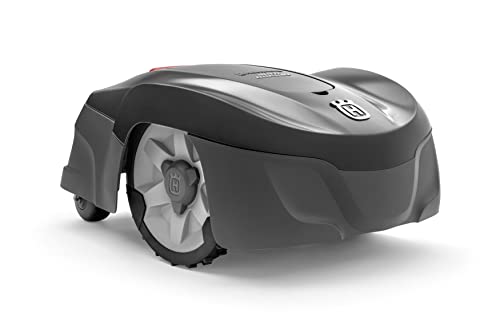
Husqvarna Automower 115H 4G Robotic Lawn Mower for 0.4 Acre
The Automower 115H 4G is a useful benchmark for owners who value an established boundary-wire system over antenna placement or camera mapping. Its high-cut orientation can suit common residential turf, but the cable installation and current listing availability should be weighed before purchase.

LawnMaster OcuMow VBRM601YCM MAX Wire-Free Robot Lawn Mower
The OcuMow MAX extends LawnMaster’s optical concept into a higher square-foot band. It is a stronger candidate than the smaller portable model when the lawn is still simple but takes too long for repeated short sessions; complex islands and indistinct edges remain the important caveats.

ANTHBOT M9 Wire-Free Robotic Lawn Mower with Garage for 1/4 Acre
The M9 listing is notable because shelter is part of the bundle rather than a separate compatibility purchase. That can simplify installation planning, though buyers should still distinguish the garage from the charging base and verify how the mower maps shaded or tree-lined sections.
Frequently asked questions
Will a more powerful mower stop getting stuck?
Not automatically. Ground clearance, turning geometry, navigation, tire design, slope rating, and property preparation matter as much as drive power.
Can I put boards over a bad area?
Improvised ramps can shift, become slippery, interfere with blades, or create an edge. Use stable landscaping or an approved transition solution.
Why does it get stuck only after rain?
Soft soil, mud-packed tread, wet leaves, and reduced grip can turn a normally passable location into a trap.
Bottom line
Use the answer above as a decision framework, then verify the exact product manual, current listing and conditions in your own lawn. Model generations, software features and included accessories can change.