Choose the end of the mowing season
Stop before persistent frost, saturated ground, or dormant grass turns routine operation into rutting and wheel slip. Finish with a dry mowing day if possible. Save maps, schedules, serial information, and app credentials. Mark dock and antenna positions before moving hardware so spring installation does not require guessing or an avoidable complete remap.
Clean, dry, and inspect
Shut down fully and use the approved handling position. Brush debris from the underside, wheels, cooling paths, and charging area; use moisture only as permitted. Replace damaged blades now or record the need for spring. Look for cracked tires, loose parts, cable cuts, corrosion, and water intrusion. Allow every washable surface to dry before enclosed storage.
Prepare the battery correctly
Follow the model’s specified storage state, charging method, and recharge interval. Some packs remain installed; others may have a documented removal procedure. Store away from combustibles and temperature extremes, and inspect periodically for swelling, leakage, odor, or heat. Do not use a timer, maintainer, or substitute charger unless the maker explicitly approves it.
Deal with the station and yard hardware
Some charging stations can remain outdoors with power and a fitted cover; others should be disconnected and stored. Isolate power before handling terminals. Cap or weatherproof exposed connectors using approved parts, leave buried boundary wire undisturbed, and secure an RTK mount if it stays in place. Photograph wiring labels so the spring reconnection is unambiguous.
Store for security and serviceability
Keep the mower upright or in the documented orientation on a stable shelf where it cannot fall, flood, or be reached by children. Avoid hanging it by the handle unless that is approved. Do not stack items on the chassis or lenses. Record storage date, charge state, blade status, firmware version, and the planned midwinter check on a tag beside the unit.
For a product-led next step, compare Robotic Lawn Mowers for Hills or use the yard-fit finder.
Products to evaluate against this advice
As an Amazon Associate, we may earn from qualifying purchases.
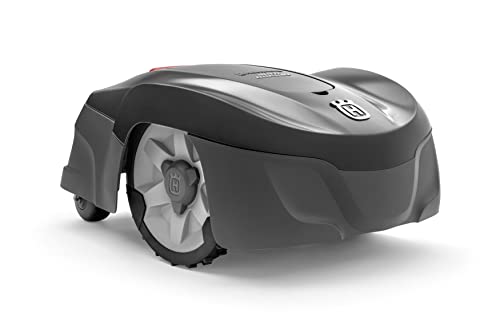
Husqvarna Automower 115H 4G Robotic Lawn Mower for 0.4 Acre
The Automower 115H 4G is a useful benchmark for owners who value an established boundary-wire system over antenna placement or camera mapping. Its high-cut orientation can suit common residential turf, but the cable installation and current listing availability should be weighed before purchase.

LawnMaster OcuMow VBRM601YCM MAX Wire-Free Robot Lawn Mower
The OcuMow MAX extends LawnMaster’s optical concept into a higher square-foot band. It is a stronger candidate than the smaller portable model when the lawn is still simple but takes too long for repeated short sessions; complex islands and indistinct edges remain the important caveats.

ANTHBOT M9 Wire-Free Robotic Lawn Mower with Garage for 1/4 Acre
The M9 listing is notable because shelter is part of the bundle rather than a separate compatibility purchase. That can simplify installation planning, though buyers should still distinguish the garage from the charging base and verify how the mower maps shaded or tree-lined sections.
Frequently asked questions
Can a robotic lawn mower stay in its garage all winter?
A small outdoor cover is not necessarily suitable seasonal storage. Temperature, moisture, power, and battery rules for the exact model decide.
Should I charge the battery to 100 percent before storage?
Not universally. Use the specified storage charge and maintenance interval rather than applying a generic lithium-battery rule.
Do I need to remove boundary wire for winter?
Normally buried boundary wire remains in place. Protect disconnected ends and station leads according to the installation guide.
Bottom line
Use the answer above as a decision framework, then verify the exact product manual, current listing and conditions in your own lawn. Model generations, software features and included accessories can change.