RTK uses an outdoor coordinate system
Ordinary satellite positioning is not precise enough to define a lawn edge reliably. RTK improves it by applying correction data from a nearby reference source or network. With favorable reception, the mower can follow stored coordinates and repeat planned lanes without a boundary wire. Accuracy may fall when buildings, dense foliage, terrain, or antenna placement obstruct or reflect satellite signals.
LiDAR reads nearby geometry
A LiDAR sensor measures distances to surrounding surfaces and builds a local spatial picture. It can use trees, walls, fences, and other stable shapes as navigation context without depending entirely on clear sky. Performance can still be challenged by reflective materials, sparse environments, heavy contamination on the sensor window, moving objects, or scenes that look different after major landscaping changes.
Installation requirements differ
An RTK system may need careful placement of a reference antenna, or it may obtain correction service through a network. LiDAR-centered products often emphasize automatic scanning and may avoid a separate antenna. Neither approach is truly setup-free: the charging station still needs a suitable location, boundaries must be reviewed, exclusion zones need testing, and narrow transitions deserve observation.
Obstacle avoidance is not guaranteed by either label
RTK primarily answers where the mower is, not what sits in front of it. LiDAR can reveal an object’s shape or distance, but software decides whether to stop, steer around it, or treat it as vegetation. Many machines add cameras for classification. Compare documented obstacle behavior and real testing instead of assuming that navigation technology alone protects toys, animals, or garden equipment.
Complex yards benefit from redundancy
A mower that fuses satellite, ranging, vision, wheel, and inertial data may continue more gracefully when one source becomes uncertain. That advantage depends on good software and thoughtful sensor placement. Ask what happens during signal loss, whether mowing pauses or continues, how recovery works, and whether the owner can see low-confidence areas before choosing the most elaborate system.
For a product-led next step, compare Wire-Free Robotic Lawn Mowers or use the yard-fit finder.
Products to evaluate against this advice
As an Amazon Associate, we may earn from qualifying purchases.

ANTHBOT M5 LiDAR Robotic Lawn Mower
This M5 is the LiDAR-identified version in ANTHBOT’s catalog. Its page should be compared against the separate non-LiDAR M5 ASIN, because sensing hardware can affect setup, obstacle detection and performance under tree cover even when the model family name looks nearly identical.

ANTHBOT M5 RTK and Vision Robotic Lawn Mower
The non-LiDAR M5 ASIN belongs on its own page only because Amazon identifies a different navigation configuration. It may appeal to yards with good satellite visibility, while the similarly named LiDAR version warrants separate setup and obstacle-detection questions.
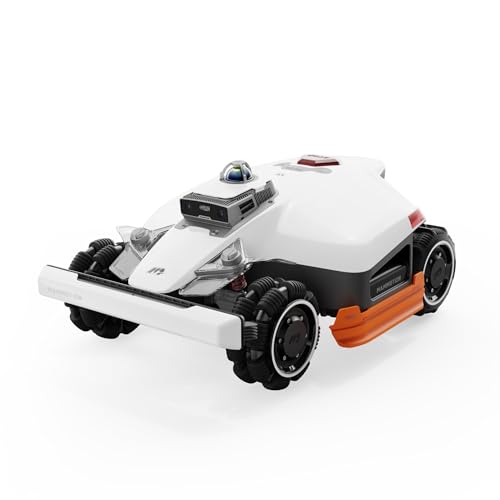
Mammotion LUBA 3 AWD 3000H Robot Lawn Mower for 0.75 Acre
The LUBA 3 AWD 3000H is specifically the high-cut 3000H identity, not a generic LUBA 3. Its 80% slope claim and multi-sensor navigation target demanding properties, but weight, wet-ground behavior and access between zones deserve close scrutiny.
Frequently asked questions
Does LiDAR work under trees better than RTK?
It can be less dependent on satellite visibility, making it attractive for canopy-heavy yards. Results still depend on the mower’s full sensor suite, the density of stable surroundings, and its mapping software.
Does every RTK mower need an antenna in the yard?
No. Some use a local reference station, while others can receive correction data through a supported network. Coverage, connectivity, fees, and fallback behavior should be verified for the exact model.
Is a hybrid RTK and LiDAR mower always best?
Not automatically. Hybrid sensing can improve resilience, but yard fit, cutting performance, service support, app quality, and recovery from errors remain equally important ownership factors.
Bottom line
Use the answer above as a decision framework, then verify the exact product manual, current listing and conditions in your own lawn. Model generations, software features and included accessories can change.