Measure rise over run
Use a level, straight board or suitable digital tool to measure vertical rise across a known horizontal distance. Divide rise by run and multiply by 100 for percent grade. Do not confuse percent with degrees. Product literature may use either format, so convert carefully before comparing the result with the manual.
Find the difficult transition
The steepest point may be a short lip at the top, a drainage swale or the turn needed at the bottom. Measure those transitions separately. A machine that climbs the main face can still lose contact when its deck or chassis crosses an abrupt change in angle.
Consider direction and traction
Driving straight up a grade is different from traversing sideways or turning on it. Wet turf, loose soil, exposed roots and sparse grass reduce grip. More aggressive wheels may improve traction but can mark soft ground. Judge a mower by documented conditions and a supervised property test when one is available.
Protect edges and hazards
A slope ending at a pond, wall, public path or drop needs a margin that follows the manufacturer's safety instructions. Navigation accuracy should not be the only barrier protecting a dangerous edge. Physical edging, exclusion zones or conventional mowing may be appropriate for that section.
Plan the station route
The mower must reach and leave its charger reliably, often at a specified orientation and grade. A flat station placed beyond a steep pinch point is not useful if the machine cannot return with a low battery. Trace the entire return route and check separate guide-wire or corridor requirements.
For a product-led next step, compare Robotic Lawn Mowers for Hills or use the yard-fit finder.
Products to evaluate against this advice
As an Amazon Associate, we may earn from qualifying purchases.
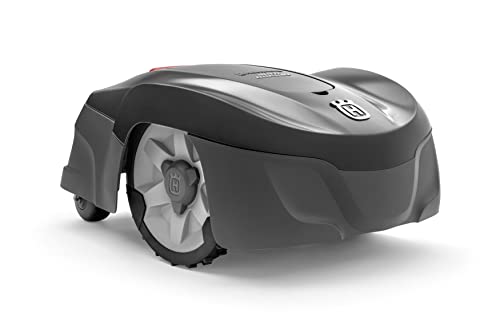
Husqvarna Automower 115H 4G Robotic Lawn Mower for 0.4 Acre
The Automower 115H 4G is a useful benchmark for owners who value an established boundary-wire system over antenna placement or camera mapping. Its high-cut orientation can suit common residential turf, but the cable installation and current listing availability should be weighed before purchase.

LawnMaster OcuMow VBRM601YCM MAX Wire-Free Robot Lawn Mower
The OcuMow MAX extends LawnMaster’s optical concept into a higher square-foot band. It is a stronger candidate than the smaller portable model when the lawn is still simple but takes too long for repeated short sessions; complex islands and indistinct edges remain the important caveats.

ANTHBOT M9 Wire-Free Robotic Lawn Mower with Garage for 1/4 Acre
The M9 listing is notable because shelter is part of the bundle rather than a separate compatibility purchase. That can simplify installation planning, though buyers should still distinguish the garage from the charging base and verify how the mower maps shaded or tree-lined sections.
Frequently asked questions
What is the difference between degrees and percent slope?
They are different measurements. A 45-degree slope equals a 100 percent grade, not 45 percent.
Will all-wheel drive solve every hill problem?
No. AWD can improve traction, but the mower still has stated grade, boundary, surface and safety limits.
Can a robot mower cross a wet hill?
Grip may fall sharply on wet turf. Use weather controls and scheduling guidance from the manufacturer, and avoid rutting soft soil.
Bottom line
Use the answer above as a decision framework, then verify the exact product manual, current listing and conditions in your own lawn. Model generations, software features and included accessories can change.