Convert acreage into an operating plan
Measure mowable turf by zone and remove buildings, woods, ponds and hardscape. Then estimate when mowing is actually allowed around irrigation, children, pets and quiet hours. A model may advertise sufficient area yet depend on near-continuous operation that the property cannot accommodate. The useful capacity is the area it can maintain inside the owner's real schedule, not a theoretical maximum.
Treat charging as part of coverage
Large areas may require repeated trips to the dock. Examine charge time, resume logic, route back to work and whether distant zones receive fair attention. A station placed at one extreme can waste travel time. Some properties benefit from central placement, guide paths or more than one mower, but those choices depend on the exact system rather than a blanket acreage rule.
Test the weak parts of the map
The open center of a large lawn is usually easy. Signal shadows behind buildings, remote corners, narrow connectors and tree lines reveal whether navigation is suitable. Walk those sections before choosing RTK, vision, LiDAR or boundary wire. For satellite-assisted systems, base-station location can matter as much as mower specifications. For wired systems, repair access across a long perimeter deserves planning.
Separate residential and commercial needs
A high-capacity residential mower may suit a broad home lawn, while a commercial property can require fleet controls, service response, operating logs and stronger protection against tampering. Do not infer durability from acreage alone. Review duty-cycle language, warranty terms and supported deployment type. A pair of smaller units can provide redundancy, though it also creates two docks and two maintenance schedules.
Budget for the whole ownership system
Large lawns consume blades and expose wheels, seals and batteries to more hours. Check parts availability, authorized repair options, winter storage instructions and the method for moving a disabled mower. Current purchase price is only one variable and can change. A more serviceable machine may be the better value when downtime would let several acres grow beyond the robot's preferred cutting pattern.
For a product-led next step, compare Wire-Free Robotic Lawn Mowers or use the yard-fit finder.
Products to evaluate against this advice
As an Amazon Associate, we may earn from qualifying purchases.

LawnMaster OcuMow VBRM601YCM MAX Wire-Free Robot Lawn Mower
The OcuMow MAX extends LawnMaster’s optical concept into a higher square-foot band. It is a stronger candidate than the smaller portable model when the lawn is still simple but takes too long for repeated short sessions; complex islands and indistinct edges remain the important caveats.

ANTHBOT Genie 3000 Wire-Free Robotic Lawn Mower for Large Yards
The Genie 3000 is the high-capacity member of the verified Genie group. Its value is less about owning the biggest model and more about whether the yard requires several mapped areas, long travel distances and dependable route planning between them.
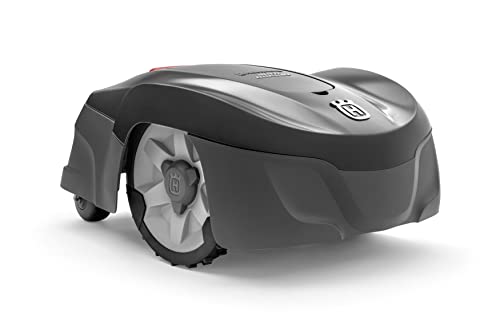
Husqvarna Automower 115H 4G Robotic Lawn Mower for 0.4 Acre
The Automower 115H 4G is a useful benchmark for owners who value an established boundary-wire system over antenna placement or camera mapping. Its high-cut orientation can suit common residential turf, but the cable installation and current listing availability should be weighed before purchase.
Frequently asked questions
Can a robotic mower maintain several acres?
Some systems are designed for multi-acre work, but the exact area, schedule, slopes, zone layout and support requirements must all fit. Verify the current model documentation.
Is one large mower better than two smaller units?
One mower simplifies ownership; two can divide zones and preserve partial coverage during service. Compare docks, power, mapping and maintenance before choosing a fleet approach.
Does a large lawn require GPS or RTK?
Not always. Those systems can help map broad open areas, while boundary wire or hybrid navigation may work better where trees and structures obstruct reception.
Bottom line
Use the answer above as a decision framework, then verify the exact product manual, current listing and conditions in your own lawn. Model generations, software features and included accessories can change.