Define zones by operation
Divide the lawn where access, cutting height, growth or schedule changes. Two adjacent areas may be one operational zone, while identical lawns on opposite sides of a locked gate are separate jobs. Record each area's square footage so the total capacity calculation remains accurate. Label whether the robot can drive between them or must be carried, because that distinction changes the daily routine.
Inspect every connector
Measure gates, grass corridors, bridges and permitted paving crossings. Confirm minimum width, slope and surface rules in the current manual. A mower that can physically squeeze through may still lack the positional tolerance or turning room required by its boundary system. Gates also need a dependable open period; an unexpected closure can trap the machine away from its station.
Understand map and schedule limits
Check how many working areas, exclusion zones and schedules the selected generation supports. A brand may change these capabilities across apps or firmware. Determine whether the owner can assign different days or cutting heights and whether the mower resumes an interrupted zone. Avoid building the purchase around a feature described only for a neighboring model or future update.
Plan separated-area handling
Some mowers can be carried to a secondary area and started without a dock, while others depend on station or guide information. Review the exact relocation sequence and safe lifting method. If carrying becomes frequent, weight and grip matter. A second machine costs more to own but can remove manual transfers and keeps one zone operating when the other unit needs service.
Prevent zone starvation
Distant or difficult sections may receive less mowing if the robot repeatedly spends its time near the dock. During commissioning, inspect completion across the property rather than admiring activity in the easiest lawn. Adjust priorities, corridor settings or schedules using documented controls. A multi-zone installation succeeds when grass condition stays even, not when the app merely shows several colored polygons.
For a product-led next step, compare Wire-Free Robotic Lawn Mowers or use the yard-fit finder.
Products to evaluate against this advice
As an Amazon Associate, we may earn from qualifying purchases.

ANTHBOT Genie 3000 Wire-Free Robotic Lawn Mower for Large Yards
The Genie 3000 is the high-capacity member of the verified Genie group. Its value is less about owning the biggest model and more about whether the yard requires several mapped areas, long travel distances and dependable route planning between them.
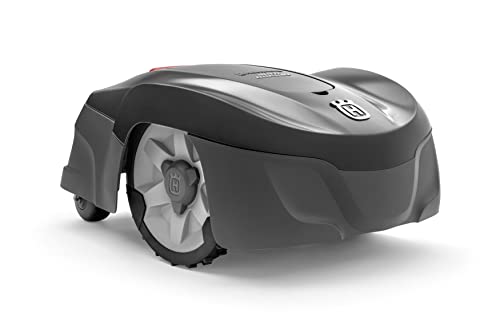
Husqvarna Automower 115H 4G Robotic Lawn Mower for 0.4 Acre
The Automower 115H 4G is a useful benchmark for owners who value an established boundary-wire system over antenna placement or camera mapping. Its high-cut orientation can suit common residential turf, but the cable installation and current listing availability should be weighed before purchase.

LawnMaster OcuMow VBRM601YCM MAX Wire-Free Robot Lawn Mower
The OcuMow MAX extends LawnMaster’s optical concept into a higher square-foot band. It is a stronger candidate than the smaller portable model when the lawn is still simple but takes too long for repeated short sessions; complex islands and indistinct edges remain the important caveats.
Frequently asked questions
Can one robotic mower cut front and back yards?
Yes when there is a supported route or secondary-area workflow. Gates, passages and dock access determine how automatic the process will be.
Do separate zones need separate boundary wires?
That depends on the system. Some wired installations use guide paths or secondary loops; virtual systems use maps. Follow the exact installation documentation.
Can zones use different cutting heights?
Some machines offer electronic height settings by area, while others require one manual deck position. Verify the current model and software capability.
Bottom line
Use the answer above as a decision framework, then verify the exact product manual, current listing and conditions in your own lawn. Model generations, software features and included accessories can change.