Measure the steepest strip
Use a level, inclinometer, or carefully applied rise-over-run method across multiple points in the mower's direction of travel. Short lips and diagonal crossings matter. Record the values and compare them with the exact manual rather than a retailer's generalized category label.
Inspect the runout area
Ask where the machine would go if wheels lost grip or navigation failed. Flat grass below a mild bank is different from a curb, water feature, drop, glass door, or traffic lane. Increase exclusion distance and add physical containment according to the consequence.
Keep the surface predictable
Fill holes appropriately, correct erosion, remove loose debris, and address irrigation leaks. Do not create hidden wheel traps with flexible netting or unsecured landscape fabric. Recheck the grade after soil work because settling can steepen a small transition.
Protect the docking route
A mower may approach its charger repeatedly along a narrow track. Place the station only within documented slope and clearance requirements, with a firm approach and drainage. Wheelspin near electrical contacts, puddles, or exposed cable needs correction before service resumes.
Stop after traction changes
Heavy rain, leaf fall, construction, frost, newly seeded soil, and tire wear can turn a previously acceptable bank into a problem. Pause automation and observe a supervised test in good visibility only after the site is restored and within documented limits.
For a product-led next step, compare Robotic Lawn Mowers for Hills or use the yard-fit finder.
Products to evaluate against this advice
As an Amazon Associate, we may earn from qualifying purchases.
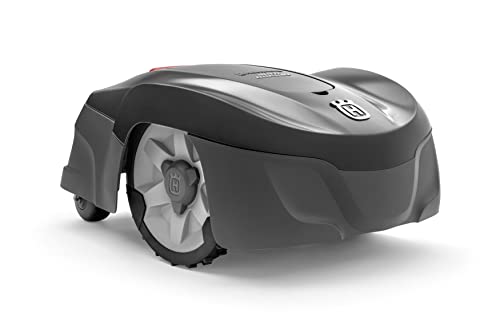
Husqvarna Automower 115H 4G Robotic Lawn Mower for 0.4 Acre
The Automower 115H 4G is a useful benchmark for owners who value an established boundary-wire system over antenna placement or camera mapping. Its high-cut orientation can suit common residential turf, but the cable installation and current listing availability should be weighed before purchase.

LawnMaster OcuMow VBRM601YCM MAX Wire-Free Robot Lawn Mower
The OcuMow MAX extends LawnMaster’s optical concept into a higher square-foot band. It is a stronger candidate than the smaller portable model when the lawn is still simple but takes too long for repeated short sessions; complex islands and indistinct edges remain the important caveats.

Redkey MGC1000 Robot Lawn Mower for 1/4 Acre and 45% Slopes
The MGC1000 pairs a conventional perimeter-wire layout with an unusually prominent slope claim for its price-oriented segment. The wired approach can be dependable after installation, but repair access and correct cable routing deserve as much attention as the mower itself.
Frequently asked questions
Is percent slope the same as degrees?
No. Percent grade is rise divided by run multiplied by 100, while degrees describe an angle. Use the unit in the mower documentation and convert carefully if necessary.
Can all-wheel drive make any hill safe?
No. Additional traction may improve capability within the product's stated limits, but surface condition, boundaries, obstacles, and downhill hazards still control whether the area is suitable.
Should the boundary be placed at the top of a drop?
Do not rely on a software or signal line as the only protection from a dangerous drop. Follow the installation clearances and use a suitable physical barrier where crossing would create harm.
Bottom line
Use the answer above as a decision framework, then verify the exact product manual, current listing and conditions in your own lawn. Model generations, software features and included accessories can change.