Test the complete route in leaf season
Leaves contain moisture and branches block different parts of the sky as the mower moves. A clear dock, patio, or base location cannot represent the whole route. Walk the proposed mowing area and identify tunnels between trees, north-facing building edges, and corners where canopy and walls overlap. If possible, evaluate during full leaf cover rather than relying on a winter setup that may change dramatically in summer.
Separate correction delivery from positioning
RTK requires correction information as well as satellite observations at the mower. Depending on the system, corrections may arrive by a local radio, network service, or another connection. A strong Wi-Fi or cellular signal does not replace a blocked satellite view, and excellent satellite reception does not guarantee that correction data reaches every zone. Check the exact system architecture before moving hardware or buying a signal accessory.
Understand the mower’s fallback behavior
Some models combine RTK with cameras, inertial sensing, wheel measurements, or other local references. These may carry the mower across a brief obstruction, but the allowed duration and accuracy vary. Determine whether the mower slows, pauses, follows a learned path, or continues with reduced certainty. Near a road, pond, stair, or drop, do not treat an undocumented fallback as protection for a virtual boundary.
Place equipment for geometry, not convenience
A reference station or antenna may need a documented view of the sky and a suitable relationship to the work area. Mounting it beside the easiest outlet can produce a poor geometry. Follow the exact height, clearance, distance, grounding, and mounting rules rather than copying another brand’s installation. Never improvise roof access or electrical work; use qualified help when safe placement is not straightforward.
Diagnose by place, season, and symptom
Record where position warnings, pauses, boundary drift, or route deviations occur and whether they change with weather or foliage. A repeatable failure beneath one canopy suggests a different cause than errors across the entire property. Preserve screenshots and logs before remapping. Firmware updates, map changes, station movement, and new construction can each alter behavior, so change one factor at a time and retest safely.
For a product-led next step, compare Robotic Lawn Mowers for Hills or use the yard-fit finder.
Products to evaluate against this advice
As an Amazon Associate, we may earn from qualifying purchases.
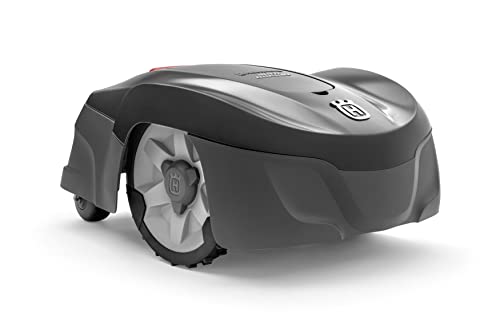
Husqvarna Automower 115H 4G Robotic Lawn Mower for 0.4 Acre
The Automower 115H 4G is a useful benchmark for owners who value an established boundary-wire system over antenna placement or camera mapping. Its high-cut orientation can suit common residential turf, but the cable installation and current listing availability should be weighed before purchase.

Redkey MGC1000 Robot Lawn Mower for 1/4 Acre and 45% Slopes
The MGC1000 pairs a conventional perimeter-wire layout with an unusually prominent slope claim for its price-oriented segment. The wired approach can be dependable after installation, but repair access and correct cable routing deserve as much attention as the mower itself.
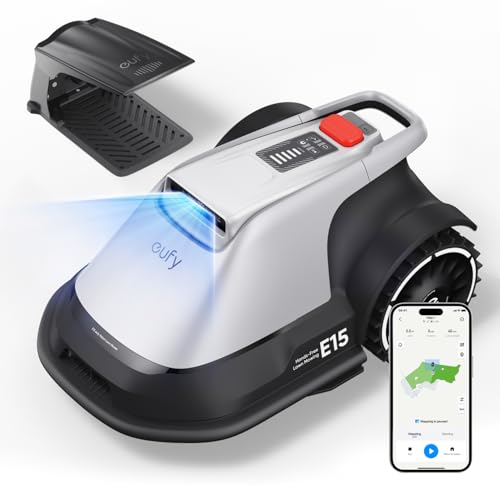
eufy E15 Pure-Vision Wire-Free Robot Lawn Mower for 0.2 Acre
The E15 uses cameras rather than a perimeter wire or separate RTK antenna, simplifying the hardware around a small yard. That shifts the buying question toward how clearly the system can read edges, obstacles and changing light in the specific landscape.
Frequently asked questions
Will RTK work under mature trees?
It may work in some canopy conditions and fail in others. Tree density, satellite geometry, nearby structures, correction delivery, season, and the mower’s fallback sensors all influence the result.
Does strong Wi-Fi fix weak RTK reception?
No. Connectivity may deliver maps, commands, or correction data, but it does not create an unobstructed satellite view at the mower. Diagnose the exact signal that is failing.
Should I map the lawn before trees leaf out?
You can begin setup then, but repeat supervised tests after full leaf cover. A route mapped under bare branches may not retain the same positioning conditions during the growing season.
Bottom line
Use the answer above as a decision framework, then verify the exact product manual, current listing and conditions in your own lawn. Model generations, software features and included accessories can change.