Blade placement sets a physical limit
Most cutting discs do not extend to the outer shell. This protects users and objects but leaves grass outside the blade path when the housing meets a wall. An offset deck or dedicated edge routine can reduce the strip, not repeal the clearance. Compare underside diagrams and independent edge tests instead of relying on a generic cut-to-edge phrase.
Level borders improve the result
Flush pavers or a firm mowing strip allow wheels to cross beyond the turf without dropping into soil. The mower can then place more of its deck over the grass edge. Borders must be wide, stable, and permitted by the product instructions. Loose stones, steep lips, public sidewalks, and vehicle routes are not equivalent to a safe private mowing strip.
Hazards demand conservative setbacks
Near water, retaining edges, stairs, traffic, or a steep drop, a small uncut margin is preferable to aggressive mapping. Virtual boundaries can be accurate without being infallible, and boundary-wire spacing also follows model rules. Use a physical barrier where appropriate and accept manual finishing rather than moving an autonomous blade system dangerously close to an open hazard.
Turns can create missed corner grass
A mower may follow a straight border closely but swing away at an inside corner or rotate on turf and leave a triangular patch. Rounded map paths, adequate turning room, and a sensible mowing strip can help. Avoid repeated tight pivoting when it scuffs the lawn; a few minutes of trimming may be gentler than forcing perfect autonomous coverage.
Edge routines require a complete route
Some mowers perform a dedicated perimeter pass before or after the main pattern. That route must remain connected and navigable around every zone. Test gates, narrow sections, and exclusions, then inspect whether the machine consistently returns to systematic mowing. Edge mode cannot compensate for poor blade condition, a misplaced boundary, or vegetation leaning in from outside the work area.
For a product-led next step, compare Wire-Free Robotic Lawn Mowers or use the yard-fit finder.
Products to evaluate against this advice
As an Amazon Associate, we may earn from qualifying purchases.

Mammotion YUKA Mini 700H Wire-Free Robot Lawn Mower
The YUKA Mini 700H is a compact high-cut member of Mammotion’s lineup. It should be selected for its particular grass-height and yard-size fit rather than assumed to share every capability of larger YUKA or LUBA models.
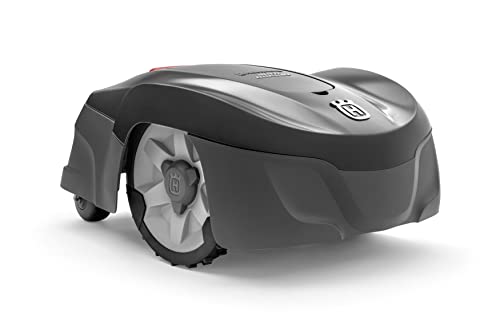
Husqvarna Automower 115H 4G Robotic Lawn Mower for 0.4 Acre
The Automower 115H 4G is a useful benchmark for owners who value an established boundary-wire system over antenna placement or camera mapping. Its high-cut orientation can suit common residential turf, but the cable installation and current listing availability should be weighed before purchase.

ECOVACS GOAT O1000 RTK Wire-Free Robot Lawn Mower for 1/4 Acre
The GOAT O1000 RTK targets buyers who want virtual boundaries without moving to a large-property machine. Its combination of satellite positioning and visual sensing is most relevant where the yard has a usable sky view and clear passages rather than dense tree cover at every edge.
Frequently asked questions
Which robot mower cuts closest to a wall?
Models with an offset cutting deck or specialized edge system may leave less grass, but wall geometry and required safety clearance still matter. Compare the exact model in a realistic border test.
Can I map the mower partly into a flower bed to cut the edge?
Do not place wheels or blades on unsupported soil merely to remove a fringe. Use the manufacturer’s setback guidance and create a stable border or trim manually.
Will a perimeter pass eliminate string trimming?
It can greatly reduce trimming along favorable level edges. Raised obstacles, posts, corners, tree guards, and hazardous borders commonly retain areas that need occasional manual finishing.
Bottom line
Use the answer above as a decision framework, then verify the exact product manual, current listing and conditions in your own lawn. Model generations, software features and included accessories can change.